Orange Concrete Contractor Pros
Menu
Concrete Walkway Installation: Cost & Steps in Orange, CA
Concrete Walkway Orange
Orange County residents seeking high-quality, long-lasting, and attractive options for their home’s concrete walkways will greatly benefit from learning about the local market cost of installing a walkway, what types of materials are needed to build a walkway, and how professionals install walkways in Orange County. In addition to these items, homeowners should be aware of how the climate in Orange County influences walkway installation, permitting procedures in Orange County, and how local market conditions affect how to plan and execute a walkway installation. A professional installation of a walkway ensures the walkway is installed per the California Building Code, provides the homeowner with years of use, and increases the overall value of their property, as well as its curb appeal. Proper planning can also help prevent common walkway issues such as cracking and/or settlement of the walkway, which could ultimately lead to drainage issues and reduce the walkway’s performance and longevity. The more a homeowner knows about the process of installing a walkway and making educated decisions regarding materials and contractors can ensure a successful installation that protects the homeowner’s investment.
Concrete Walkway Installation Costs in Orange County
The cost of installing a professional concrete walkway in Orange, CA, can range anywhere from $8 to $15 per square foot for a standard 4″ thick installation with a simple finish. Decorative premium options (such as color, stamp, or expose) can range from $12 to $25 per square foot. A typical 200 sq. ft. walkway will run from $2,000 to $3,000 for a complete installation of both material and labor.
There are also additional costs, such as site preparation (excavation), which is an average of $2 to $4 per square foot. Permit fees can range from $200 to $500, depending on the size and location of the project. If you need to remove an old walkway, there can be an additional $2 to $6 per square foot added to your overall cost. Because of the many competing contractors in Orange County, prices remain relatively low, and contractors are able to build high-quality walks that meet local building and aesthetic requirements.
Site Evaluation and Planning
All sites are evaluated by professionals to find the best place to locate the walkway, taking into consideration the flow of water around the house, the location of any utilities, and the landscape surrounding the home. The planners take into account the connection of the new walk to the existing structure and/or other buildings on the property. They consider all ADA regulations and future maintenance access points. Sites located close to Chapman University and Villa Park have more challenges due to mature trees and established landscapes.
Because of the varied soil types found throughout Orange County, clay soils found closer to areas like Angel Stadium require some form of drainage enhancement. Grading of the site allows for proper drainage while still allowing for accessible paths to be used by everyone. Professionals look for underground utilities, irrigation systems, and property boundaries to avoid conflicts when installing the walkway and during any future maintenance.
Excavation and Base Preparation
A minimum of 6 to 8 inches of excavation space is required to allow for a 2 to 4 inch layer of compacted gravel base and a 4 inch thickness of concrete as the standard for residential walkways. Building codes in Orange County require the base of the walkway to be prepared properly to prevent settling and cracking from the movement of the soil. Compacting the gravel base mechanically after it has been placed helps to create a stable subgrade that will resist future settling and help to extend the life of the walkway.
Quality construction of the gravel base allows for necessary drainage and load transfer under the walkway. Evenly graded and thoroughly compacted gravel bases provide a foundation that is stable enough to last longer than the walkway itself. Proper drainage integration is critical to preventing water accumulation that could undermine the walkway during Orange County’s occasional heavy rainfalls and irrigation system usage.
Form Construction and Reinforcement
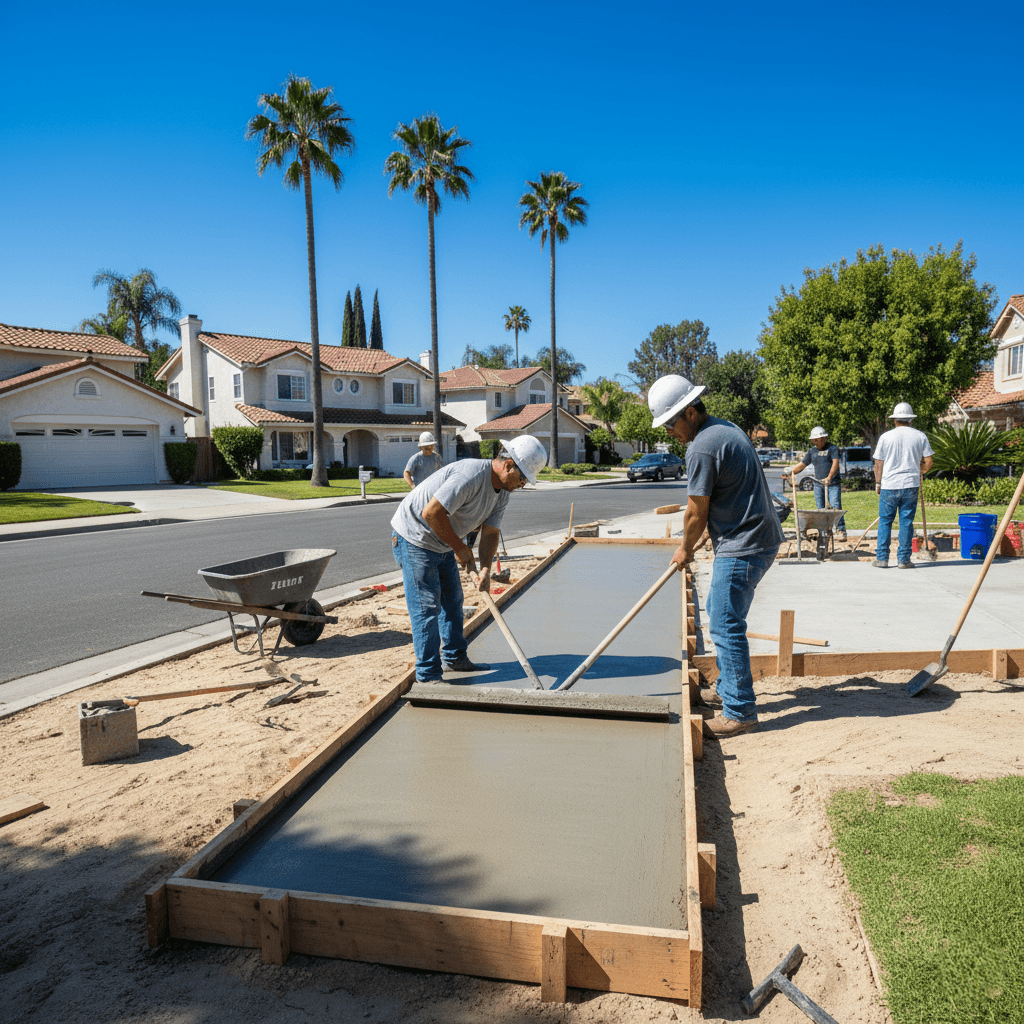
Accurate construction of forms using quality lumber and bracing provides straight lines, correct grades, and a clean edge to give a professional appearance. The forms should be strong enough to withstand the pressure of the concrete without moving or distorting during placement and finishing. Bracing strategically placed about every two to three feet provides sufficient support for the walkway to be constructed with the correct dimensions and slope.
Reinforcing wire mesh improves the walkway’s durability and crack-resistance, especially in Orange County’s seismic area. Placing the reinforcing wire mesh in the top third of the concrete thickness maximizes its effectiveness while ensuring the concrete covers the mesh adequately. Professional contractors evaluate the soil conditions and anticipated loads to determine what type and amount of reinforcement is needed for each walkway installation.
Concrete Mixing and Placement
Orange County’s climate demands careful consideration of the mix design and placement time of the concrete to prevent rapid moisture loss and promote good curing. Standard 4000 psi concrete is sufficient for residential walkways in Orange County and meets the local building code requirements. Adding air-entraining admixtures may benefit walkways installed outside, where they occasionally experience freezing and thawing cycles during the winter months.
Installation of the concrete starts at one end of the forms and works systematically to eliminate cold joints and to achieve consistent thickness throughout the walkway. Proper consolidation of the concrete eliminates air pockets and ensures that the reinforcement is in full contact with the concrete. Large installations may require placement of sections of the walkway at different times to maintain workability and quality of the finish; this may be more critical during the warmer months of Orange County.
Finishing Techniques and Surface Treatments
Leveling the screed completes the leveling of the concrete surface and establishes the grade for the drainage of water away from adjacent structures. The bull float then removes excess water from the surface of the concrete and consolidates the concrete to achieve the best possible condition for finishing. Due to Orange County’s dry climate, finishing may need to occur more quickly than in more humid climates to prevent the formation of a crust on the surface of the concrete.
Texturing the surface of the walkway increases the safety of users by providing a non-slippery surface and enhancing the aesthetics of the walkway to match the style of the property. A broom finish is a very common finish used for walkways because it provides excellent traction for day-to-day use, whereas decorative finishes may include stamping, staining, or exposing the aggregate in the concrete. Professional edging completes the finishing of the walkway and provides a clean appearance that does not chip easily and defines the boundaries of the walkway.
Curing and Quality Control
Maintaining the right balance of moisture and temperature during the curing period promotes optimal strength development of the concrete in Orange County’s climate. Applying a curing compound or using plastic sheeting prevents rapid loss of moisture from the surface of the walkway, which could negatively impact the surface quality and long-term durability of the walkway. A minimum of 7 days of curing time is required to develop sufficient strength in the walkway so it can safely be subjected to regular foot traffic.
Creating control joints in the walkway prevents random cracking by creating predetermined failure planes at designated locations. Typically, joint spacing is determined by the 2-3 times the slab thickness rule, and joints are cut to 1/4 of the total depth of the concrete. Proper timing and placement of joints significantly reduces maintenance requirements over the life of the walkway, particularly important in Orange County’s stable climate.
Permits and Code Compliance
Municipalities in Orange County require permits for most concrete walkway installations, and the specific requirements may vary based on the city and scope of the project. Professional contractors will prepare and submit the permit application, coordinate the inspections, and manage the documentation required for code compliance throughout the installation process. Obtaining proper permits protects the homeowner and ensures that the walkway is built in accordance with safety and accessibility standards.
Considerations related to ADA compliance must be taken into account when designing walkways, especially for those homes that have public access or commercial uses. Limitations regarding the slope, width, and surface texture of the walkway must be met to ensure that the walkway is accessible to all users. Professional installation ensures compliance with current building codes while providing years of reliable service and liability protection for the homeowner.
Benefits of Using a Professional Installer
Orange Concrete Contractor Pros specializes in professional concrete walkway installation that incorporates quality craftsmanship with comprehensive project management services throughout Orange County. Our team of experts manages every aspect of the project from the initial design consultation to the final inspection to ensure exceptional results that increase the property value and provide decades of reliable service. We understand local soil conditions, climate factors, and building code requirements that impact walkway performance and deliver customized solutions that meet each property’s specific needs and exceed the homeowner’s expectations for quality and durability.
LATEST POSTS