Orange Concrete Contractor Pros
Menu
Commercial Concrete Solutions in Orange, CA
Commercial Concrete Orange
Commercial concrete construction requires a great deal of forethought and careful planning by experienced engineers who will be able to construct with precision to help guarantee long term durability and safety for both people using the structure and for the longevity of the structure itself. In Orange County, the property owner or developer is becoming aware of the value of hiring an experienced contractor to install high-quality concrete for retaining walls, slabs and flatwork as these are key components of the building which provide a platform for businesses to operate on, provide durability against all types of traffic and environmental factors and ultimately protect their investment and increase the overall value of the property. By understanding best practices for commercial concrete installations, a contractor can provide the property owner with an assurance of maximum results and protection of their investment. The commercial contractor provides superior results for the client through experience and knowledge of proven methods and the use of quality materials.
Commercial Retaining Wall Engineering Specifications
The commercial retaining wall system must be engineered to be structurally sound and stable for an extended period. A professional engineer must take into consideration the type of soil, drainage requirements, seismic factors, and load-bearing specifications typical of commercial settings as part of the overall design process. The type of geotechnical study will determine the correct depth for the footing of the wall and the amount of reinforcing necessary to support a structure that has considerable loads.
Each area has its own height limitations and setbacks for retaining walls; therefore, it is essential to meet local building code requirements to complete a successful commercial project. The City of Orange mandates that a professional engineer design and build retaining walls greater than certain heights and/or supporting structures. Local ordinances help ensure the public’s safety and protect adjacent properties from potential damage resulting from the failure of a retaining wall, which could lead to costly liability claims.
Design Considerations for Structural Concrete Slab Construction
Businesses experience increased load demands due to the presence of equipment, vehicles, and people walking on them. The typical thickness for commercial concrete slabs ranges from 6 to 12 inches, depending on the intended purpose of the slab and the reinforcement pattern used to distribute the applied loads. The subgrade should be prepared correctly to prevent the foundation from settling and cracking over time.
High-stress applications, such as manufacturing floors, warehouses, and loading docks, benefit from the increased durability provided by fiber-reinforced concrete. The strategic placement of control joints allows for uncontrolled cracking while allowing the concrete to expand and contract thermally. Professionals who install commercial concrete applications know the specific concrete mixes and finishing techniques that need to be used to obtain the desired characteristics of each application.
Best Practices for Installing Commercial Concrete Flatwork
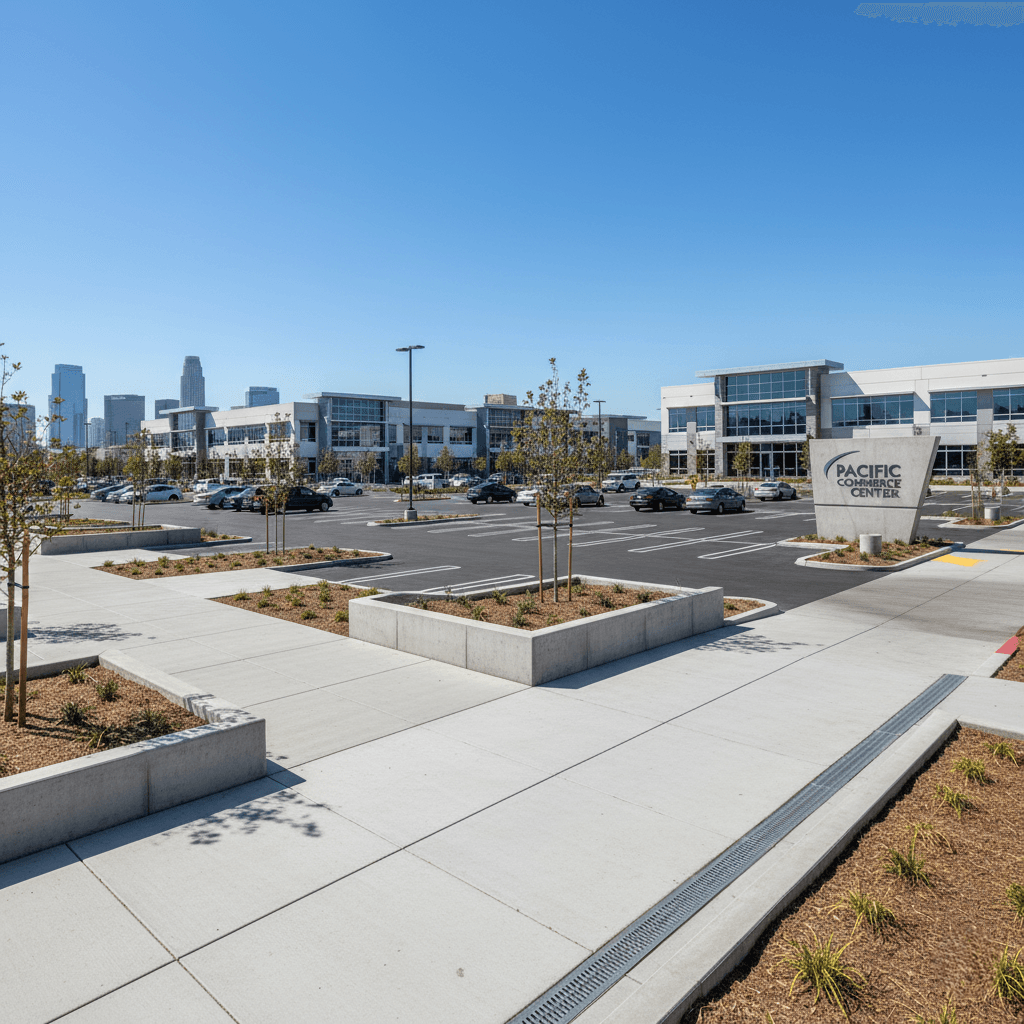
Commercial concrete flatwork includes sidewalks, parking lots, walkways, and plazas. In order to last a long time and be safe, these areas must be installed using precise techniques. Drainage design is important to keep water from accumulating under the surface and damaging the surface, thereby creating a potential liability for the owner of the property. The slope of the surface must allow for the efficient draining of water, yet still provide accessibility to people with disabilities.
There are many ways to finish the surface of commercial concrete flatwork. Broom finishes provide traction for pedestrians, while smooth trowelled finishes are ideal for driving lanes. Anti-slip additives can be added to high-traffic areas where there is a concern about slipping due to wet conditions, especially near building entries and covered walkways.
Requirements for Load-Bearing Capability
Commercial applications require concrete systems that have the capability to carry significant weight loads without compromising the structure of the concrete system. Parking lots are subject to daily traffic from vehicles, such as delivery trucks, fire trucks, police cars, etc., so they must be able to carry this type of load for the entire lifespan of the facility. The thickness and the amount of reinforcement required for the concrete system are determined by the contractor through an analysis of the expected load on the system and the frequency of that load.
Typically, the compressive strength requirement for commercial concrete flatwork is a minimum of 4,000 psi. However, depending on the application, the compressive strength of the concrete may be higher. For example, heavy-duty areas, such as loading zones, may require a 5,000 + psi concrete with additional reinforcement. Testing of the delivered concrete ensures that it meets the specification requirements before placement of the concrete.
Drainage and Water Management Systems
Proper drainage design helps to prevent damage to the concrete caused by excessive moisture, which can cause the concrete to deteriorate over time. Commercial properties must have an integrated stormwater-management system that can handle large amounts of water during peak rainfall events and protect the structural components of the property. Appropriate grading of the property directs water away from the structures and into a collection system.
Waterproofing systems and the placement of drains, the proper sloping of the surface, and the use of drainage materials, such as drainage fabric and weep holes, work together to properly manage moisture and ensure the structural integrity of the concrete.
Design and Placement of Joints
Controlled joint placement will control where cracking occurs in large concrete pours, while providing adequate allowance for thermal movement. Commercial flatwork will require expansion joints placed at specified intervals to prevent random cracking that can create maintenance issues and safety hazards. Control joints direct the cracking of the concrete to a designated location where it can be properly sealed and maintained.
Separation joints are used to isolate concrete elements that are independent and are intended to prevent stress transfer from one element to another that would potentially damage the elements. Separation joints are critical in areas where the concrete flatwork meets the foundation of the building, utility structures, and existing pavement. The separation joint should be properly sealed to maintain a watertight condition and provide the necessary allowance for thermal movement.
Durability and Finishing Techniques for Surfaces
Commercial concrete surfaces must endure extreme usage while maintaining a clean and professional appearance during their service life. Correct curing procedures will ensure that the concrete reaches its maximum strength, usually within 7 days of applying moisture to the surface. Smoothing the surface through power floating and troweling produces a dense and wear-resistant surface that is also easy to maintain.
Surface treatments can increase the slip-resistance of a surface, reduce dusting, and increase the resistance of a surface to chemicals based on the needs of the specific application. Maintaining a regular schedule for cleaning and other forms of maintenance can greatly extend the life of the surface.
Accessibility and Safety Compliance
Commercial concrete installations must meet all of the requirements of the Americans with Disabilities Act (ADA) for safety and accessibility. Sidewalks, ramps, and surfaces must meet specific standards to ensure safe travel for everyone. Tactile surfaces, proper lighting, and clear paths to travel are examples of design features that enhance the overall safety of a commercial concrete installation.
Slip-resistance becomes increasingly important in covered areas, at building entrances, and in other areas where moisture tends to accumulate. Commercial concrete contractors know how to select the best surface treatment options for each application that will meet the required safety and maintenance requirements. Ensuring compliance with local building codes ensures that commercial properties meet all relevant safety standards and reduces the risk of potential liability.
Testing and Verification of Quality Control Measures
A combination of testing methods and procedures to ensure that commercial concrete meets all requirements of the design and performance specifications. Tests conducted on fresh concrete include verifying the mix design, workability, and ultimate strength of the concrete before placing the concrete. Testing of the field includes slump tests, air-content testing, and temperature measurements that affect the final properties of the concrete.
Compression testing of cylinders cast from the concrete at 7 and 28 days of age will confirm that the compressive strength of the concrete meets the specification requirements. Core testing may be required for some applications or when the strength of the concrete is questioned. Contractors who perform commercial concrete installations maintain a record of all testing performed on the concrete to verify compliance with quality control measures during the entire duration of the project.
Excellence in Professional Installation
Large commercial concrete installations require contractors who have extensive knowledge of the complexities involved in performing large-scale installations and complying with applicable local laws and regulations. Project managers for commercial concrete projects coordinate multiple trades and ensure that the installation sequence is performed properly and that quality standards are maintained throughout the installation process. Experienced teams identify potential issues early in the installation process and thus avoid costly delays and inefficiencies.
Orange Concrete Contractor Pros specializes in commercial concrete applications that meet the demanding requirements of business environments in Orange County. We offer a variety of services, including designing and installing retaining walls, constructing structural concrete slabs, and installing commercial concrete flatwork that enhances the value of a property while providing years of durability.
LATEST POSTS