Orange Concrete Contractor Pros
Menu
Orange, CA Concrete Pouring & Curing Tips
Pouring Concrete Orange
Orange County’s warm Mediterranean climate produces specific demands on curing of the Orange, CA area concrete, which requires very close consideration of both moisture retention and temperature control. Professional techniques for placing or pouring concrete are critical to manage the high rate of evaporation, extreme heat during the summer months, and lower-than-average humidity found in the county as a whole. A proper curing process is required to ensure that concrete reaches its ultimate strength potential and also prevents surface defects and durability concerns over the life cycle of the product. Using the knowledge of regional climatic conditions, contractors and homeowners can develop an effective curing strategy that will allow the maximum performance from their concrete. The implementation of strategic moisture management and temperature monitoring will provide the best possible environment for the chemical hydration reaction to occur; this process is necessary for achieving optimal concrete strength development.
Understanding Concrete Curing in the Orange County Climate
The primary purpose of concrete curing is to create a favorable environment to facilitate chemical hydration reactions, which will develop concrete’s desired mechanical properties. Because Orange County has a dry climate, it loses moisture much quicker than climates with higher humidity, thus it is important to have increased protection measures to maintain a good curing environment compared to more humid environments. Temperatures often reach well over 80°F, which can increase the rate of evaporation to the point where it compromises both the surface quality and the ability of the concrete to gain its ultimate strength.
Once concrete has been poured, hydration continues for several weeks; however, in order to achieve 70% of the intended design strength, concrete should be cured properly for about 7 days. Orange County’s dry climate, along with occasional strong Santa Ana winds, presents an ideal situation to retain moisture; therefore, professional concrete contractors are trained to use various techniques to retain moisture and to cure their concrete optimally until it achieves its maximum performance.
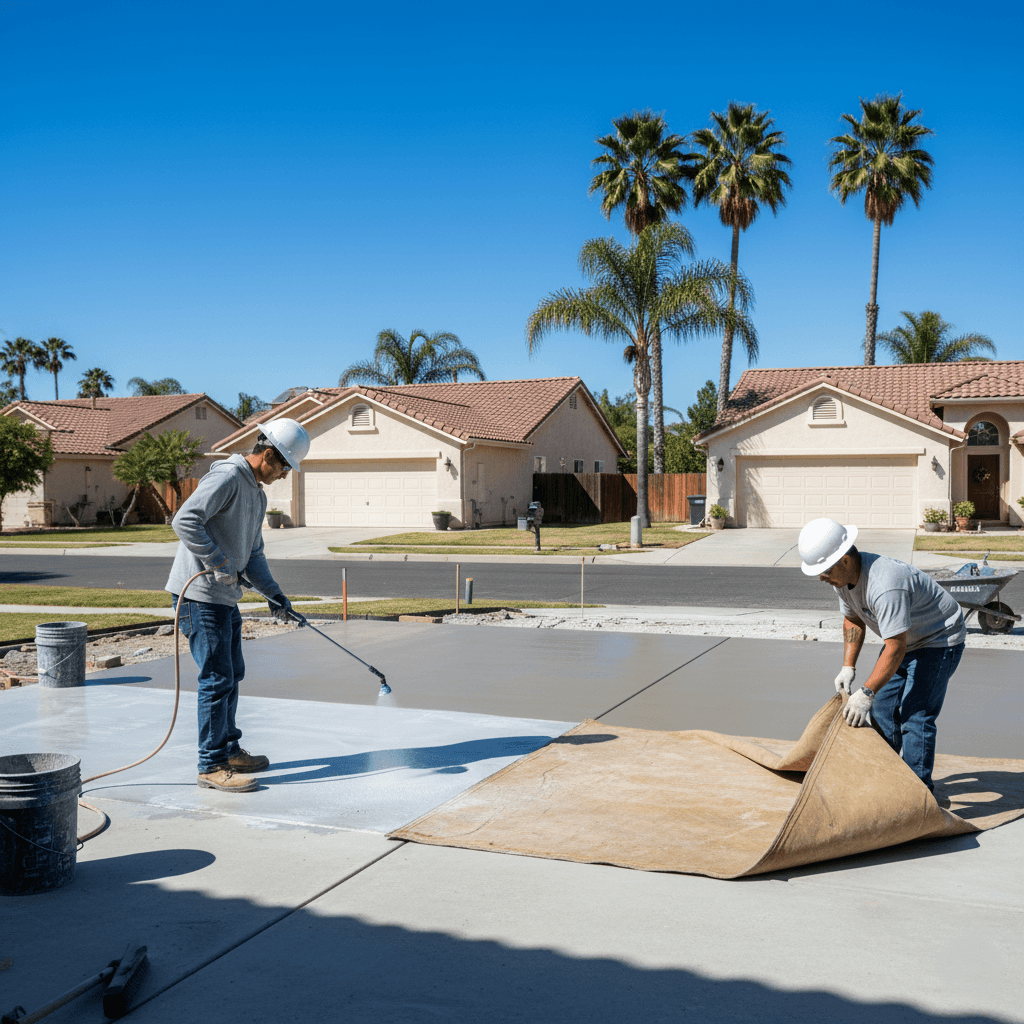
The first 24 to 48 hours after completing final finishing operations, protecting the surface of newly finished concrete is critical. The dry climate of Orange County, combined with intense sunlight and high temperatures, creates an immediate need for either applying a curing compound or using some form of physical protection to keep moisture from escaping from the surface. Physical protection of the surface of new concrete protects against plastic shrinkage cracking and also promotes even strength development throughout the entire surface of the concrete.
Temperature monitoring of the new concrete during the first few hours of the curing process is also very important. Ideally, the temperature should range from 50 to 90°F to promote optimal hydration reaction. Temperatures of 95°F or greater, which occur frequently in Orange County’s summer months, can speed up the curing process but will ultimately decrease the ultimate strength of the concrete. Professional contractors schedule the placement of concrete in the coolest part of the day (usually morning or late evening) to minimize the thermal stresses on freshly placed concrete throughout the neighborhoods near Chapman University and Villa Park.
Techniques for Retaining Moisture Include
- Water curing is the best method of retaining moisture, as it keeps the surface of the concrete consistently saturated throughout the duration of the strength development period. Sprinklers, soaker hoses, or ponding methods are all viable options for retaining moisture and preventing excessive evaporation that is typical of Orange County’s dry climate. Frequent misting (every two to three hours) during daylight hours can also help to counteract the excessive evaporation caused by the dry climate.
- Membrane curing compounds create a barrier that reduces the amount of moisture that can escape from the surface of the concrete while still allowing the hydration reaction to continue. High-quality liquid membrane compounds, applied immediately after finishing, provide 7 days of moisture retention, which is generally sufficient for most residential applications. Plastic sheeting is another option for protecting the surface of new concrete; however, care must be taken to install the sheeting correctly to prevent moisture from collecting on the surface of the concrete and causing damage.
Strategies for Controlling Temperature Include
- Hot weather concreting practices become a necessity when temperatures exceed 77-95°F, which is typical of Orange County’s summer months. Shading devices protect freshly poured concrete from the sun’s rays and allow for air movement to provide a healthy curing environment. Windbreaks reduce the rate of evaporation and prevent the formation of a crust on the surface of the concrete, which would result in a lower quality finish.
- Pre-cooled materials, such as chilled mixing water, shaded aggregate storage, and insulated delivery vehicles, reduce the temperature of the concrete during placement. Scheduling pours to take place during the cooler morning hours minimizes the effects of heat stress and provides adequate daylight to complete finishing tasks in areas such as Anaheim Hills and the Angel Stadium area.
Duration of Curing and Strength Development
Typical curing periods vary from 7 to 28 days based on the specific needs of the project and the conditions that the concrete will be exposed to. Due to Orange County’s relatively stable climate, it is possible to follow a consistent curing schedule without regard to weather-related interruptions that may be encountered in other locations. A minimum of 7 days of moist curing will provide the concrete with adequate early strength development for most residential applications, such as driveways, patios, and walkways.
Strength development of concrete follows predictable patterns if curing conditions are maintained throughout the critical curing period. At 7 days, concrete will generally have reached 70 percent of its design strength. It takes a full 28 days of optimal curing conditions to obtain the maximum strength potential for the concrete. Due to the mild winters found in Orange County, it is possible to construct concrete year-round without concerns related to cold weather that may cause extended curing periods or affect the final quality of the concrete.
Common Curing Problems and Prevention
Plastic shrinkage cracking develops when the surface of the concrete dries out faster than bleeding water can replenish it. The combination of hot and dry conditions that prevail in Orange County makes it difficult to prevent this type of cracking. Surface crazing is a result of rapid drying of the surface of the concrete, resulting in a network of fine cracks that can detract from the appearance and durability of the concrete. Both of these problems can be prevented through proper moisture retention and wind protection during the initial curing phase.
If the surface of the concrete is allowed to dry too quickly, dusting will occur, and a weak layer of material will develop on the surface of the concrete. Dusting is an indication that there was insufficient moisture available during the early stages of curing and will affect the long-term performance of the concrete. Color variations may develop due to uneven curing conditions that existed on the surface of the concrete. By employing systematic moisture management and environmental protection throughout the critical curing period in Orange County’s challenging climate, professional contractors can avoid these problems.
Considerations for Seasonal Curing
Pours made during the summer months require special protection from heat stress and excessive moisture loss during the peak temperature months in Orange County. Pours made during the morning hours allow the contractor to complete the pour before the heat of the day increases andprovides adequate protection to the concrete during the curing process. In contrast, pours made during the winter months benefit from the mild temperatures found in Orange County but may require longer curing periods during those rare occasions when cool temperatures may delay the hydration process.
During the rainy season, consideration must be given to protecting the concrete from becoming oversaturated and weakening the surface of the concrete during the curing process. Protecting the surrounding area from standing water will provide the needed moisture while preventing over-saturation of the concrete. Professional contractors plan their scheduling accordingly to accommodate the varying weather patterns found in Orange County to provide the best curing conditions possible and to limit any adverse effects that may arise during the critical curing and strength development period.
Quality Control and Monitoring
Monitoring the moisture content of the concrete throughout the curing period is crucial to determine whether the hydration reactions are occurring in a satisfactory manner. Checking the surface temperature of the concrete will help to determine if excessive heat stress exists and whether additional protection measures need to be taken. Visual inspection of the surface of the concrete will reveal any signs of surface defects that may indicate improper curing conditions and require correction.
Documentation of the curing procedures employed by the contractor serves as proof of compliance with the warranty and performance specifications of the product and as a record of successful techniques used on previous projects in Orange County’s diverse property types.
Professional Curing Services
Orange Concrete Contractor Pros employs a comprehensive curing program tailored specifically for Orange County’s unique climate conditions to ensure optimal performance and longevity of the concrete. Our experienced staff recognizes the relationship between proper curing and the long-term success of concrete and utilizes tested methods that consider the local temperature, humidity, and environmental conditions. Our company provides systematic moisture management, temperature monitoring, and protection measures to maximize the strength development of the concrete and to minimize the risk of common curing-related problems to deliver superior results that protect our clients’ investments and provide decades of reliable service in Orange County’s harsh climate conditions.
LATEST POSTS